Is Austin, Texas Safe? What the Crime Data Actually Shows
This post may contain affiliate links. If you use them, we may earn a commission at no extra cost to you. Please see our disclaimer page for more information.
Key Takeaways
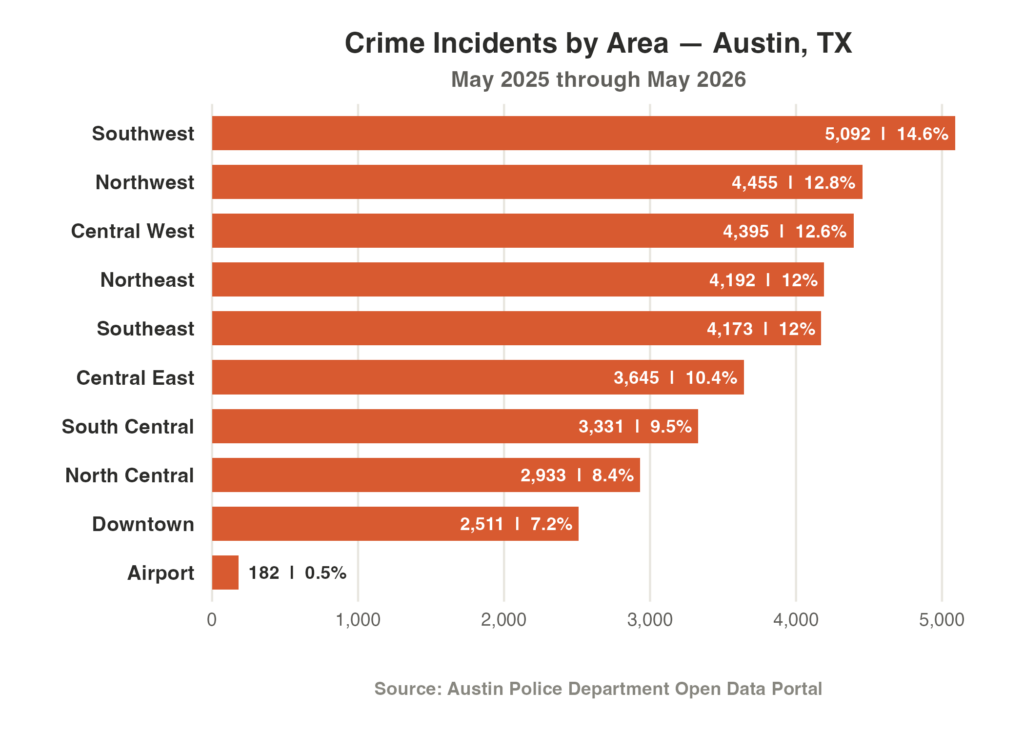
- Southwest Austin recorded the highest share of incidents at 14.6%, followed closely by Northwest (12.8%) and Central West (12.6%)
- Downtown Austin, often perceived as high-risk, actually accounts for just 7.2% of all reported incidents, lower than eight other sectors
- North Central and Downtown are the two safest residential sectors by reported incident share
- The data covers 13 months of verified Austin Police Department records — not estimates or surveys
This analysis includes only crimes classified under the FBI’s Uniform Crime Reporting (UCR) program which is a nationally standardized framework covering serious offenses. Minor violations, traffic incidents, and non-UCR calls for service are excluded. This ensures the numbers reflect meaningful criminal activity rather than all police contact.
If you’ve ever Googled “is Austin safe” before booking an Airbnb, apartment hunting, or planning a night out, you’ve probably landed on vague answers full of generalities and outdated statistics. This post cuts through that noise with actual APD incident data spanning May 2025 through May 2026, over 35,000 reported incidents broken down by city residential areas.
Austin is a growing city. With a population of the metro area surpassing two million, Austin carries the crime footprint you would expect from a major Texas metro. But the picture is far from uniform across the city, and where you are in Austin matters more than most people realize.
The Southwest sector leads all areas with 5,092 incidents over the 13-month period, representing 14.6% of all citywide crime. This covers a broad swath of South and West Austin including areas around Slaughter Lane and William Cannon, high-density corridors with heavy commercial activity and significant residential growth in recent years. Northwest Austin follows at 12.8%, and Central West at 12.6%, making the western half of the city the most active zone for reported incidents overall.
The Northeast and Southeast sectors each sit at exactly 12%, suggesting the eastern side of Austin carries a comparable burden to the west, distributed more evenly across its two sectors.
What surprises most people is Downtown. At just 7.2%, Austin’s urban core ranks second lowest among all residential sectors. This likely reflects the nature of Downtown crime, incidents do occur, but the resident population is small relative to the sector’s footprint, and APD presence is concentrated there. North Central comes in at 8.4%, making it and Downtown the two quietest sectors in the dataset.
The Airport sector, covering the area around Austin-Bergstrom International Airport, records just 0.5% of incidents, but this is not a fair comparison to residential neighborhoods given the nature of the area.
The bottom line: if you are choosing where to live or visit in Austin, the data suggests the northern and central parts of the city tend to see fewer reported incidents, while the southwestern and northwestern corridors carry the heaviest load. No part of Austin is crime-free, but the differences between sectors are real and measurable — and now you have the numbers to see them clearly.
Data source: Austin Police Department Open Data Portal.
Custom Research and Analysis: Need a specialized evaluation or help interpreting specific datasets? We provide professional statistical analysis and custom reporting tailored to your requirements. Contact us to request a custom report.