Income Level is Linked to Obesity: Data Analysis
This post may contain affiliate links. If you use them, we may earn a commission at no extra cost to you. Please see our disclaimer page for more information.
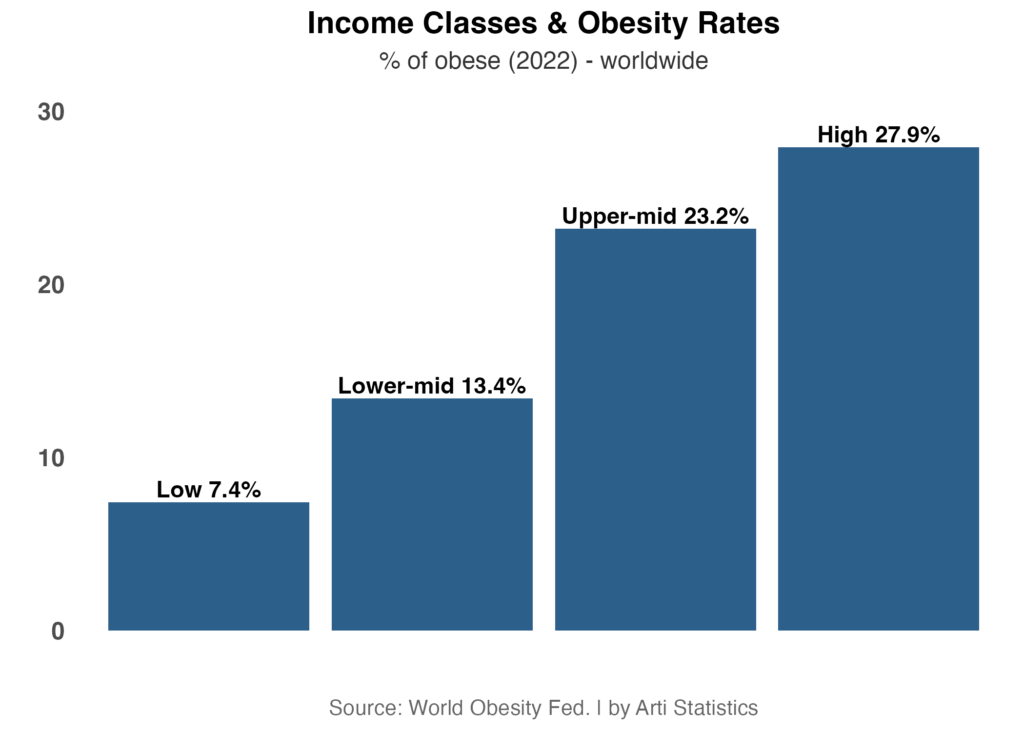
This analysis examines obesity rates across 196 countries using 2022 data, grouped by World Bank income classification into four categories: high income, upper-middle income, lower-middle income, and low income.
Key Takeaways
- High-income countries have the highest average obesity rate at 27.9%, nearly four times higher than low-income countries at 7.4%
- The relationship between national income and obesity is statistically significant, by a one-way ANOVA (F = 34.17, p < 0.001)
- Upper-middle income countries average 23.2% obesity, while lower-middle income countries average 13.4%, a clear stepwise pattern as income rises
- Post-hoc testing confirms that high income countries differ significantly from both low and lower-middle income nations
- The only non-significant difference is between high income and upper-middle income countries, suggesting obesity converges at the top of the income scale
The data tells a story that challenges conventional thinking. Wealth is supposed to mean better healthcare, better nutrition, and healthier populations. Instead, higher national income is strongly associated with higher obesity rates.
High income nations average an obesity rate of 27.9%, almost double that of lower-middle income countries at 13.4%, and nearly four times that of low-income countries at 7.4%. The pattern is remarkably consistent and statistically robust across all 196 countries in the dataset.
Further statistical tests reveal where the sharpest divides lie. High income countries differ significantly from both low income and lower-middle income nations. Upper-middle income countries also differ significantly from both lower-middle- and low-income groups. The only boundary that blurs is between high and upper-middle income, suggesting that once a country crosses a certain wealth threshold, obesity rates begin to converge.
The explanation likely lies in what prosperity brings, unlimited food access, sedentary lifestyles, and poor self-control. High-income populations have every resource to eat well yet the data suggests that abundance without discipline is its own risk factor.
Also, see Top 10 Most Obese Countries in the World.
Data Source: NCD RisC Collaboration, via World Obesity Federation.